

Will Urine Incontinence Sunderland EMS (Electromagnetic Seat) Treat Me?
If you are dealing with urine leakage, one of the first questions is probably whether treatment will actually make a difference.
The answer is often yes, but it depends on what is causing the leakage and what type of urinary incontinence you have.
Stress incontinence, urgency incontinence, mixed incontinence and other urinary symptoms can have different causes and may need different approaches. Treating the wrong problem is unlikely to produce the result you are looking for.
That is why a useful treatment plan starts with understanding your symptoms, not choosing a treatment simply because it is non-surgical.
What Is Urinary Incontinence?
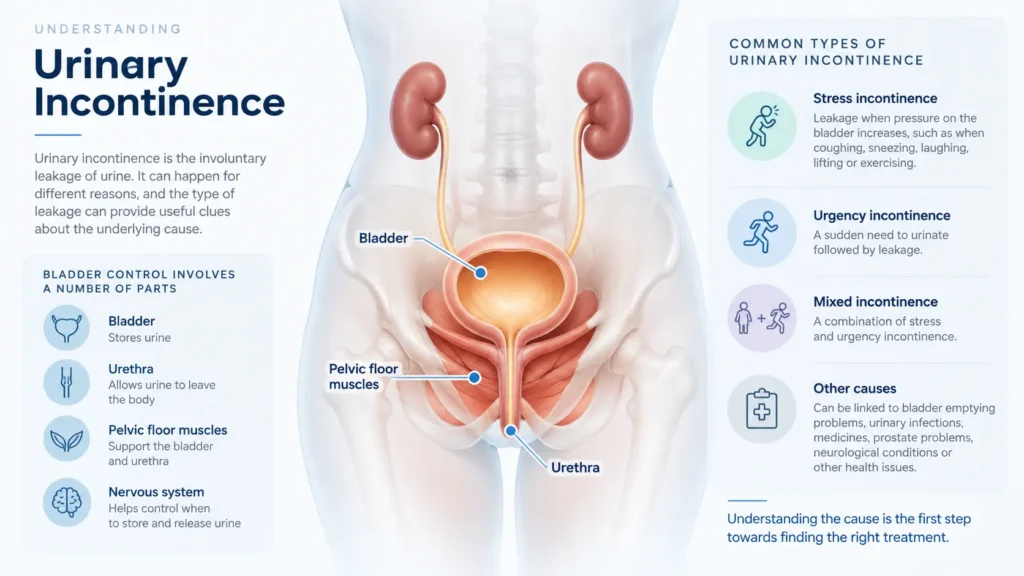
Urinary incontinence is the frequent involuntary leakage of urine.
It can happen for different reasons, and the leakage pattern can provide useful clues.
Stress urinary incontinence: This involves leakage when pressure on the bladder increases, such as when coughing, sneezing, laughing, lifting or exercising.
Urgency urinary incontinence: This involves a sudden need to urinate followed by leakage.
Mixed urinary incontinence: This combines features of stress and urgency incontinence.
Other urinary symptoms can be linked to problems with bladder emptying, urinary infections, medicines, prostate problems, neurological conditions or other health issues.
That is why urinary leakage shouldn’t automatically be treated as a simple case of weak pelvic-floor muscles.
Urinary Incontinence Treatment Options: What to Consider
| Treatment Option | How It Works | Where It May Fit | Practical Considerations | Limitations |
|---|---|---|---|---|
| EMS (Electromagnetic Seat) | Chair-based electromagnetic stimulation intended to produce repeated pelvic-floor muscle contractions while the person remains seated and clothed. | An option for people interested in exploring electromagnetic pelvic-floor stimulation. | Requires little active movement during the session and is delivered externally. | Evidence is still developing. Research involving one electromagnetic system or protocol should not automatically be applied to another. |
| Pelvic-Floor Muscle Training | Involves deliberately contracting and relaxing the pelvic-floor muscles as part of a structured exercise programme. | An established treatment for urinary incontinence. NICE recommends supervised training for women with stress or mixed urinary incontinence. | Usually requires regular practice and correct technique. A healthcare professional may assess pelvic-floor muscle function and provide guidance. | Some people have difficulty identifying or contracting the pelvic-floor muscles correctly and may need additional support. |
| Bladder Training | Uses structured techniques to gradually increase the interval between the sensation of needing to urinate and passing urine. | Particularly relevant to urgency or mixed urinary incontinence. | Requires regular practice over a period of time. | It is not intended to address every type or cause of urinary incontinence. |
| Lifestyle and Fluid Management | May include reviewing caffeine intake, fluid intake, weight and other factors that can affect urinary symptoms. | Can form part of conservative management alongside other treatments. | Changes are incorporated into everyday routines rather than delivered as a procedure. | The appropriate changes depend on the individual’s symptoms. Excessive fluid restriction is not a universal treatment. |
| Medication | Prescription medicines can be used for selected urinary symptoms, depending on the type of incontinence and the person’s circumstances. | May be considered when conservative measures are insufficient or unsuitable for particular symptoms. | Requires medical assessment and consideration of other medicines, health conditions and possible side effects. | Medicines are not suitable for every type of urinary incontinence and can have side effects. |
| Incontinence Products | Products such as absorbent pads, pants and other continence aids are used to manage urine leakage. | Useful while symptoms are being assessed, while treatment takes effect, or where ongoing leakage needs practical management. | Available in different forms and absorbency levels to suit individual needs. | These products manage leakage but do not treat the underlying cause of urinary incontinence. |
| Specialist Procedures or Surgery | Depending on the diagnosis, specialist treatment may include procedures, nerve stimulation, injections or surgery. | Usually considered when appropriate conservative treatments have not provided sufficient benefit or are unsuitable. | Requires specialist assessment and discussion of the potential benefits, risks and alternatives. | The available procedures differ according to the type and cause of incontinence and are not appropriate for everyone. |
| Note: Treatment options are not interchangeable. The most appropriate approach depends on the type and cause of urinary incontinence, the severity of symptoms, medical history and individual circumstances. A healthcare professional can help determine which options are appropriate. | ||||
Why Does Urinary Incontinence Happen?
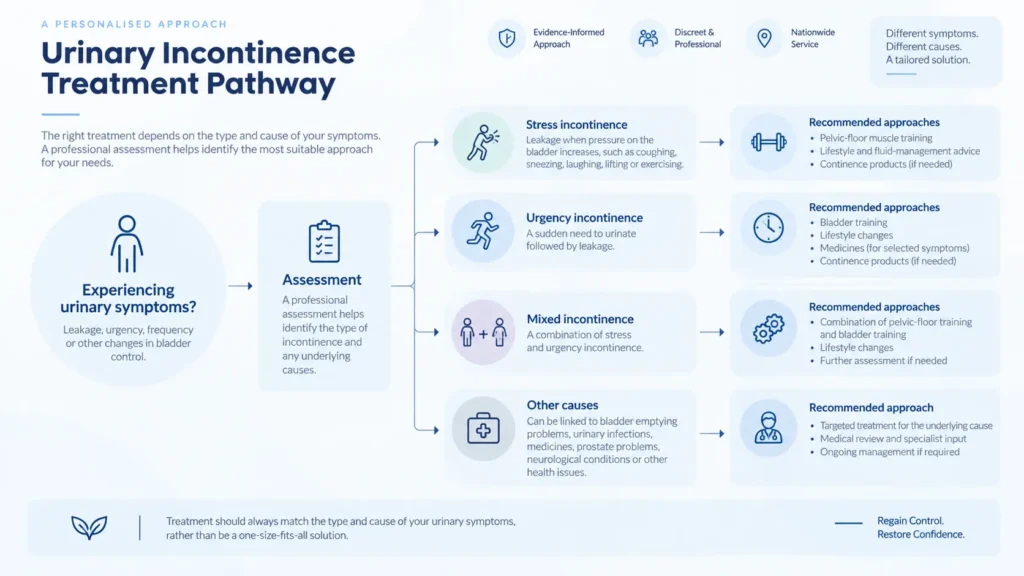
The bladder, urethra, sphincter muscles, pelvic floor and nervous system all contribute to normal bladder control.
For some people, changes to pelvic-floor muscle function can contribute to stress urinary incontinence. In other cases, there may be a different or additional cause.
For example, NHS guidance notes that urinary incontinence can result from several different conditions and that treating an underlying cause may resolve the incontinence in some cases.
In men, urinary symptoms can also be associated with prostate enlargement or other lower urinary tract problems. NICE recommends assessing possible causes, medical conditions and current medicines rather than assuming that one explanation applies to everyone.
Can Urinary Incontinence Be Treated?
Yes. There are several established approaches, and the appropriate one depends on the type and severity of the symptoms.
Treatment may include:
- pelvic-floor muscle training
- bladder training
- lifestyle and fluid-management changes
- medicines for selected urinary symptoms
- continence products where appropriate
- specialist treatments or surgery in selected cases
For women with stress or mixed urinary incontinence, NICE recommends a supervised pelvic-floor muscle training programme lasting at least three months as a first-line treatment.
For women with urgency or mixed urinary incontinence, bladder training is recommended for a minimum of six weeks as a first-line treatment.
After prostatectomy, men experiencing stress urinary incontinence should be offered supervised pelvic-floor muscle training. NICE advises continuing the exercises for at least three months before moving on to other treatment options.
These recommendations matter because they show treatment should match the type of urinary problem rather than be a one-size-fits-all solution.
Will Treatment Completely Stop the Leakage?
Not necessarily.
Some people experience substantial improvement, while others may need ongoing management.
The outcome depends on factors such as the type of incontinence, its underlying cause, how long the symptoms have been present and which treatment is being used.
If an underlying or root problem is identified and successfully treated, the incontinence may sometimes resolve. In other situations, the realistic goal is to reduce leakage, urgency or frequency and make everyday activities easier.
A treatment provider should therefore be careful not to promise that urinary leakage will disappear completely.
What Is Usually Tried First?
Conservative treatment is commonly considered before medication or surgery.
NHS guidance lists lifestyle changes, pelvic-floor muscle training and bladder training among non-surgical approaches to urinary incontinence.
For stress urinary incontinence in women, supervised pelvic-floor muscle training has an established place in treatment.
For urgency symptoms, bladder training can help manage the timing and frequency of urination.
The right approach depends on the symptoms.
For example, someone whose main problem is leakage when coughing may need a different plan from someone who experiences a sudden, difficult-to-delay urge to urinate.
What About Pelvic-Floor Muscle Training?
Pelvic-floor muscle training involves deliberately contracting and relaxing the pelvic-floor muscles.
It is not simply a matter of doing as many contractions as possible. Correct technique matters, which is why NICE recommends assessment of pelvic-floor muscle contraction before supervised training for urinary incontinence in women.
For women with stress or mixed urinary incontinence, NICE recommends a supervised programme lasting at least three months.
For men who develop stress urinary incontinence after prostatectomy, NICE also recommends supervised pelvic-floor muscle training for at least three months.
This makes pelvic-floor muscle training an important reference point when considering other approaches to pelvic-floor stimulation.
Where Does an EMS Chair Fit In?
Incontinence Direct Sunderland provides a private mobile service using electromagnetic pelvic-floor stimulation.
The chair-based treatment is delivered while the customer remains seated and clothed. The electromagnetic stimulation is intended to produce pelvic-floor muscle contractions without the person having to perform each contraction voluntarily.
This differs from conventional pelvic-floor muscle training.
It is also important not to treat every form of electrical or electromagnetic stimulation as the same treatment. Research may involve different technologies, equipment and protocols, so evidence needs to be matched carefully to the intervention being discussed.
What Does the Research Say About Electromagnetic Stimulation?
Research into electromagnetic stimulation for urinary incontinence has increased in recent years.
A 2025 systematic review and meta-analysis examined seven studies of high-intensity focused electromagnetic therapy in women with urinary incontinence. The authors reported improvements in some urinary symptoms and quality-of-life measures compared with control groups.
That finding is relevant, but it needs careful interpretation.
The review involved a relatively small number of studies, and the treatment protocols and study populations were not necessarily identical. More recent research has also reported potential benefits from magnetic stimulation for female stress urinary incontinence, while noting heterogeneity and limitations that make larger, better-designed trials desirable.
There is another important distinction. Studies of electrical stimulation, including intravaginal electrical stimulation, are not automatically evidence for a chair-based electromagnetic treatment. A 2025 systematic review specifically comparing electrical stimulation with pelvic-floor muscle training found very low-certainty evidence and did not find electrical stimulation to be superior to pelvic-floor muscle training for stress urinary incontinence.
So the responsible conclusion is not that EMS is a guaranteed treatment. It is that electromagnetic stimulation is an area of clinical research with some encouraging findings, while the evidence still needs to be considered in the context of the particular technology, population and treatment protocol.
How Does an EMS Chair Session Work at Incontinence Direct Sunderland?
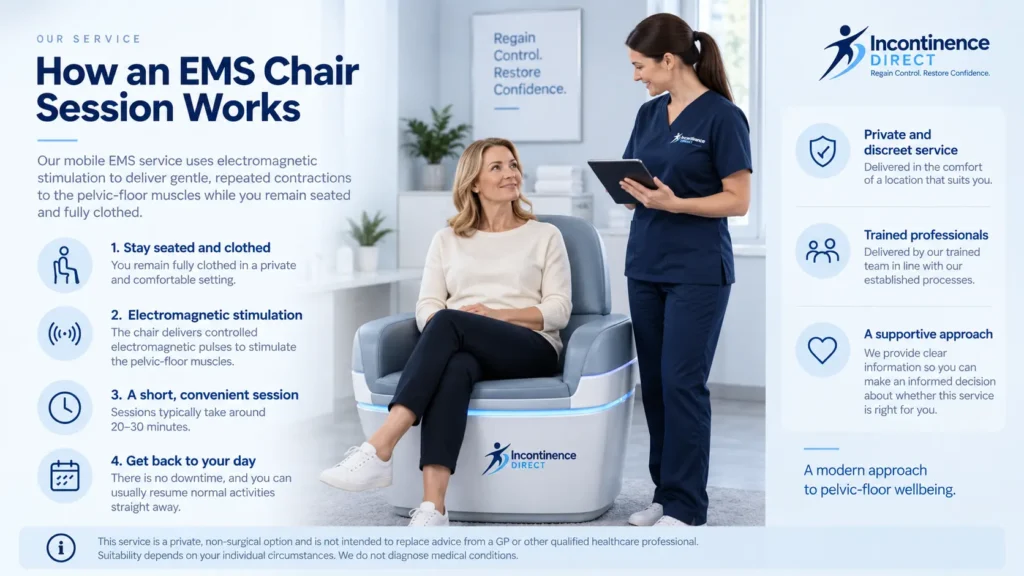
During the chair-based service, you remain seated and clothed while the electromagnetic stimulation is delivered.
The treatment is intended to produce repeated pelvic-floor muscle contractions.
The experience is therefore different from performing pelvic-floor exercises yourself, because the contractions are generated through the treatment equipment.
The exact session schedule should not be presented as a universal medical prescription. Research studies use their own protocols, and those protocols should not automatically be transferred to every commercial service or individual.
Who Might Consider an EMS Chair?
An EMS chair may be something to discuss if you are interested in electromagnetic pelvic-floor stimulation and have already considered the nature of your urinary symptoms.
However, there is no responsible way to say that everyone with urinary incontinence is a suitable candidate.
If you have unexplained, new or worsening urinary symptoms, it is sensible to establish the likely cause before choosing a private treatment.
This is particularly relevant where there may be urinary infection, difficulty emptying the bladder, neurological symptoms, prostate-related problems or another underlying condition.
Can EMS Replace Pelvic-Floor Exercises?
It should not be presented as a replacement.
Pelvic-floor muscle training has an established role in the management of stress urinary incontinence, and NICE specifically recommends supervised training for women with stress or mixed urinary incontinence.
Electromagnetic stimulation is a different approach.
Someone considering EMS can therefore discuss it separately from pelvic-floor rehabilitation rather than assuming that one automatically makes the other unnecessary.
What If I Have Urgency or Frequent Urination Rather Than Leakage?
The treatment approach may be different.
Urgency, frequency and urgency incontinence can be associated with overactive bladder and other conditions.
For women with urgency or mixed urinary incontinence, NICE recommends bladder training for at least six weeks. It can also help to review everyday habits, such as how much caffeine and fluid you are having, as these may be considered part of managing symptoms.
Men with storage symptoms may also be advised on bladder training, fluid intake, and lifestyle measures after assessment.
This is one reason the phrase “urinary incontinence treatment” covers a much wider group of problems than stress incontinence alone.
When Should I Speak to a GP?
You should consider medical assessment if your urinary symptoms are new, unexplained, worsening, or significantly interfering with daily life.
Assessment is particularly important if you have symptoms such as:
- blood in the urine
- pain when passing urine
- recurrent urinary infections
- difficulty emptying your bladder
- significant changes in urinary frequency
- new neurological symptoms
- symptoms suggesting a prostate or other urinary problem
NICE recommends investigating possible causes and relevant medical conditions as part of assessment rather than assuming that all urinary symptoms have the same origin.
FAQs: Urine Incontinence Treatment with EMS (Electromagnetic Seat)
Can urinary incontinence be treated?
Yes. Treatment depends on the type and cause of the incontinence. Options can include pelvic-floor muscle training, bladder training, lifestyle changes, medication and, in selected cases, specialist procedures or surgery.
What is the best treatment for urinary incontinence?
No single treatment is best for everyone. Stress, urgency and mixed incontinence can require different approaches, which is why assessment is important.
Can an EMS chair help urinary incontinence?
Electromagnetic stimulation has been studied for urinary incontinence, particularly in women, and some studies have reported improvements in symptoms and quality of life. However, the evidence does not show that every EMS system produces the same results.
Can EMS replace pelvic-floor exercises?
It should not be presented as a replacement for established pelvic-floor muscle training. The two approaches work differently and have different evidence bases.
Will I notice an improvement after a few sessions?
No one can promise improvement after a specific number of sessions. Research findings vary, and you can’t predict individual responses from a general treatment schedule.
Is EMS suitable for men?
Men can develop urinary incontinence for different reasons. Reasons include symptoms following prostate surgery. Suitability for electromagnetic stimulation depends on the individual’s circumstances and should not be assumed based on urinary leakage alone.
Will treatment cure my urinary incontinence?
There is no universal answer. Some causes can be treated, and the leakage may resolve, while other people need longer-term symptom management. A treatment provider should not promise a particular outcome without understanding the underlying problem.
Can pelvic-floor exercises help with urine leakage?
They can. Supervised pelvic-floor muscle training is a first-line treatment for women with stress or mixed urinary incontinence, and NICE also recommends it for men with stress urinary incontinence following prostatectomy.
Is EMS the same as pelvic-floor muscle training?
No. Pelvic-floor muscle training involves voluntarily contracting the pelvic-floor muscles. An EMS chair uses electromagnetic stimulation to produce muscle contractions through the treatment equipment.
How many EMS sessions will I need?
No single schedule can responsibly apply to everyone. Published studies use different treatment protocols, and a research schedule should not automatically be treated as a prescription for a private service.
How long will EMS results last?
There is not enough evidence to promise a fixed duration of benefit for every person. Claims such as “results last six to twelve months” should not be treated as a guarantee.
Should I see my GP before considering EMS?
If your symptoms are new, unexplained, worsening or accompanied by other concerning urinary symptoms, medical assessment should come first. A private treatment should not replace investigation of a possible underlying condition.
Will Urinary Incontinence Treatment Help You?
It can, but the useful question is not simply whether a treatment works.
The more important question is which treatment fits the type of urinary problem you actually have.
For some people, pelvic-floor muscle training or bladder training may be the appropriate starting point. Others may need medication, investigation of an underlying condition or specialist treatment.
Electromagnetic pelvic-floor stimulation is another approach that has been studied, with research showing potentially useful changes in some urinary incontinence outcomes. The evidence is still developing, however, and it should not be presented as a guaranteed cure or as a replacement for established care.
Incontinence Direct Sunderland provides a private mobile electromagnetic pelvic-floor stimulation service for people who want to explore this option.
If you are considering treatment, understanding the cause and pattern of your symptoms is the sensible place to start.
Sources & Further Reading
NHS — Urinary incontinence
NHS — Non-surgical treatment for urinary incontinence
NICE — Urinary incontinence and pelvic organ prolapse in women: management (NG123)
NICE — Lower urinary tract symptoms in men: management (CG97)
Medical Information Notice
This article provides general information and does not diagnose urinary incontinence or replace advice from a GP or other qualified healthcare professional.
The research discussed on this page relates to specific interventions, populations, and treatment protocols. Evidence relating to one electromagnetic or electrical stimulation system should not automatically be interpreted as evidence for another.
Individual suitability and treatment outcomes vary.
Last Reviewed: September 2026 By Incontinence Direct Sunderland Editorial Team